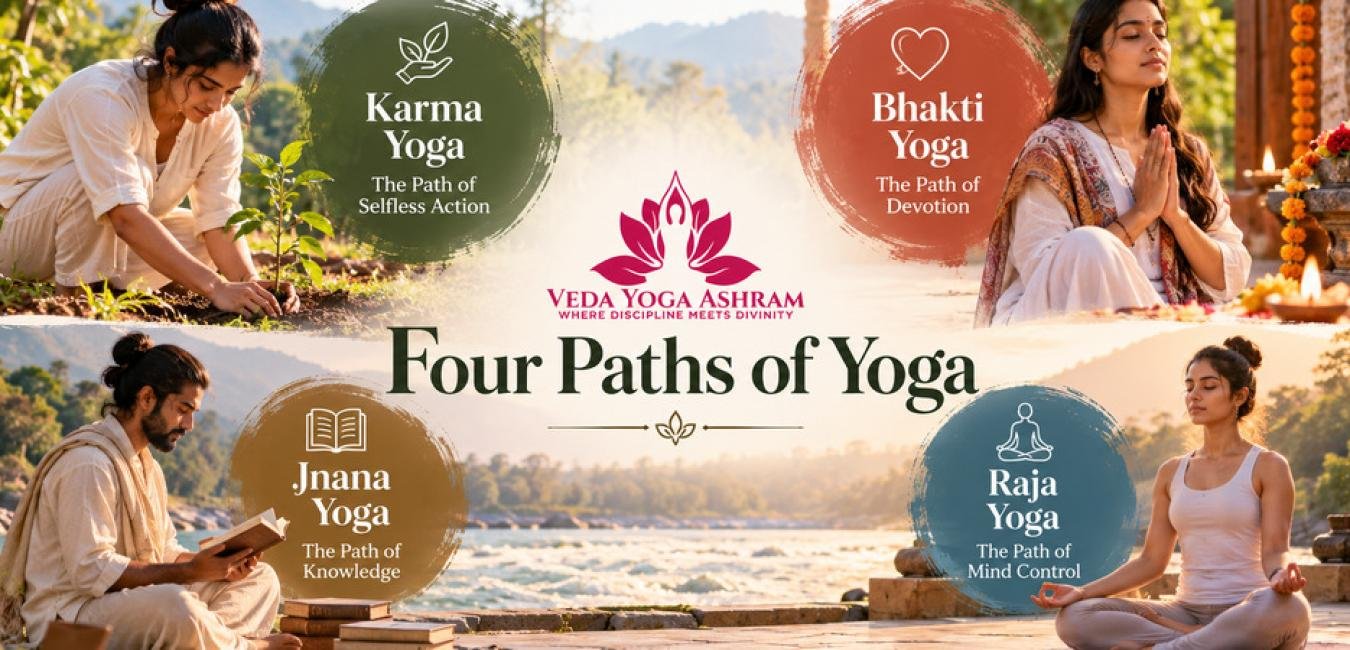
Four Paths of Yoga: A Practical Guide for International Students in RishikeshOur Yoga Blogs
Most people meet yoga on a mat. They stretch, breathe and leave class a little calmer. Then they arrive in India, open a book on yoga philosophy, and find words like karma, bhakti, jnana and raja. Suddenly yoga looks much bigger than a physical class.
Those four words sit at the center of the four paths of yoga, a framework Hindu teachers have used for generations to explain spiritual growth. The idea is simple. People differ, so the road to self-understanding differs too. Some learn by doing, some by feeling, some by thinking and some by sitting still.
This guide explains each path in plain language, shows how to practice it in daily life, and points out the mistakes students often make. It is written for international students who plan to study in Rishikesh, Uttarakhand, or who want to understand the philosophy before they travel.
Table of Contents
- What Are the Four Paths of Yoga?
- One Mountain, Several Trails
- The Four Yogas Hinduism Describes in Its Texts
- Karma Yoga: The Path of Selfless Action
- Bhakti Yoga: The Path of Devotion
- Common Bhakti Practices
- Jnana Yoga: The Path of Knowledge
- Raja Yoga: The Path of Meditation and Mental Discipline
- 4 Types of Yoga and Who Each One Suits
- Paths Versus Class Styles
- Can You Combine the Four Paths of Yoga?
- Studying the Four Paths of Yoga in Rishikesh
- Common Mistakes When Choosing Among the Four Paths of Yoga
- Conclusion
What Are the Four Paths of Yoga?
The four paths of yoga are Karma Yoga (action), Bhakti Yoga (devotion), Jnana Yoga (knowledge) and Raja Yoga (meditation and mental discipline). Each one is a method for reaching the same goal. Different texts name that goal in different ways: self-realization, liberation (moksha), or union of the individual self with something larger.
The word yoga comes from the Sanskrit root yuj, which means to join. A path of yoga is therefore a way of joining what feels separate, such as the small ego and the wider awareness behind it.
One Mountain, Several Trails
Picture a single mountain with four trails up the slope. One is steep and direct, another winds through forest, a third follows a river. All reach the summit, but the walker's temperament decides which one feels natural. The four paths of yoga work the same way. A warm, emotional person may find devotion easier than abstract philosophy. A restless, practical person may prefer service.
Nobody stays on one trail forever. Most students end up borrowing from all four.
The Four Yogas Hinduism Describes in Its Texts
Hindu scripture does not present the four paths of yoga as one tidy list. The Bhagavad Gita, a conversation between the warrior Arjuna and Krishna, explains action without attachment in its third chapter and devotion in its twelfth. Knowledge and meditation run through several others. The Upanishads focus on inquiry into the self. Patanjali's Yoga Sutras lay out the eight-limbed system behind Raja Yoga. They were compiled roughly two thousand years ago, though scholars debate the exact date.
Swami Vivekananda popularized the four-part grouping in the West through his lectures in the 1890s. Later teachers such as Swami Sivananda kept the framework and stressed balance. This history explains why different ashrams may lean toward different paths.
Karma Yoga: The Path of Selfless Action
Of the four paths of yoga, Karma Yoga is the one you can start at your desk today. It asks you to act fully while loosening your grip on the result. The Gita puts it simply: you have a right to your work, not to its rewards. This does not mean working carelessly. It means giving full effort and letting go of the fantasy of praise, promotion or control.
For a student, this has practical meaning. Imagine a group project where one teammate keeps taking credit. A karma yogi still does the best work possible, then lets the credit question go. The effort stays honest, and resentment has nothing to feed on. Selfless service does not mean tolerating harm. Healthy boundaries belong to the path too.
Ways to Practice Karma Yoga
-
Do one daily task, such as sweeping or washing dishes, with full attention and no complaint.
-
Volunteer for something with no reward attached. Many ashrams include seva, or selfless service, in the daily schedule.
-
Before a big task, ask what your duty is. Then ask where you are attached to the outcome.
-
At the end of the day, notice one action you did for its own sake.
Bhakti Yoga: The Path of Devotion
Bhakti Yoga turns the emotions toward something higher than personal wants. In the Hindu tradition, that object of love is often a deity such as Shiva, Krishna or Devi. Other practitioners direct it toward the divine in nature, in a teacher or in all living beings. The aim is to soften the ego through love and surrender. Many teachers call Bhakti the most approachable of the four paths of yoga, since everyone already knows how to love.

Devotion does not require you to adopt a religion. Many international students come from other faiths or none, and teachers in India are used to that. Treat the practices as forms of attention and gratitude, and take part with respect.
Common Bhakti Practices
Mantra repetition, called japa, is the easiest entry point. A well-known example is Om Namah Shivaya, often understood as "I bow to Shiva," the pure awareness within. Students usually count repetitions on a mala of 108 beads. Kirtan, call-and-response chanting with harmonium and drums, brings devotion into a group. Satsang, a gathering to hear teachings and share silence, supports both. Try a simple start. Sit for five minutes each morning, repeat the mantra silently, and finish with a moment of thanks.
Jnana Yoga: The Path of Knowledge
Within the four paths of yoga, Jnana is the most philosophical. It is the path of inquiry, and it keeps returning to one question: who am I? The practitioner questions every identity, such as job title, nationality or mood, and looks at what remains when each one is set aside. The classical phrase is neti neti, meaning "not this, not this."
Vedanta describes three stages. First comes listening to the teachings (shravana). Next comes reflection until doubts are settled (manana). Last comes sustained contemplation, where the insight sinks in (nididhyasana). Reading alone is not enough. Knowledge becomes yoga only when it changes how you see.
Teachers also warn that this path needs a steady mind. The Sivananda tradition, for example, advises building a base in the other paths first. An anxious or sleep-deprived student can turn inquiry into overthinking.
A small exercise: at night, write down a belief you hold about yourself, such as "I am bad with languages." Ask what evidence supports it and what contradicts it. Then sit quietly and ask who is holding the belief.
Raja Yoga: The Path of Meditation and Mental Discipline
Among the four paths of yoga, Raja is the one most Western classes touch, usually without naming it. Raja means "royal," and the path works directly on mastery of the mind. Patanjali's eight limbs form its map. Most studio classes teach only the third limb, posture, so many students are surprised by how much more the system contains.
The Eight Limbs at a Glance
-
Yama: ethical restraints, such as non-violence and truthfulness
-
Niyama: personal observances, such as cleanliness and contentment
-
Asana: steady posture
-
Pranayama: breath regulation
-
Pratyahara: drawing attention away from the senses
-
Dharana: concentration on one point
-
Dhyana: meditation, an unbroken flow of attention
-
Samadhi: complete absorption, the traditional goal
The limbs are not rungs you finish one at a time. A beginner can work on ethics, posture and breath in the same week.
Daily meditation sits at the center of the practice. The U.S. National Institutes of Health says meditation carries few risks for most people, though some report difficult experiences. If you have a history of trauma or anxiety, tell your teacher and begin with short sessions.
4 Types of Yoga and Who Each One Suits
Traditional teachers match the path to temperament. The four paths of yoga suit different natures, so treat the table below as a starting guess, not a personality test. Modern science does not confirm these categories, and most people are a mix.
|
Path |
Natural fit |
Core practice |
Common trap |
|
Karma |
Active, practical, service-minded |
Selfless work, seva |
Burnout or resentment |
|
Bhakti |
Emotional, warm, devotional |
Mantra, kirtan, prayer |
Sentiment without discipline |
|
Jnana |
Analytical, curious |
Study, self-inquiry |
Intellectual pride |
|
Raja |
Methodical, introspective |
Meditation, breath, ethics |
Rigid perfectionism |
Paths Versus Class Styles
Many people searching for yoga types expect hatha, vinyasa or yin. Those are styles of physical practice, and they belong mostly to Raja Yoga's postures and breath. The paths are bigger than any style. You can take a vinyasa class as karma yoga if you practice without chasing results. You can take it as bhakti if you dedicate it to someone.
Can You Combine the Four Paths of Yoga?
Yes, and most teachers hope you will. Swami Sivananda called this approach the yoga of synthesis, a balance of head, heart and hands. A simple weekly rhythm shows how it can look:
-
Morning: ten minutes of meditation and breath (Raja)
-
Daytime: one task done as selfless service (Karma)
-
Evening: mantra or chanting (Bhakti)
-
Weekend: reading and reflection on one question (Jnana)
Adjust the proportions as you learn. If you feel dry, add devotion. If you feel scattered, add meditation. If you feel stuck in your head, add service.
Studying the Four Paths of Yoga in Rishikesh
Books give you vocabulary. Living inside a community gives you practice. Rishikesh sits on the Ganga in the foothills of the Himalayas and has drawn yoga students from around the world for many years. Ashram life tends to blend the four paths of yoga naturally, with early meditation, shared chores, evening chanting and philosophy talks.
If you want to study these ideas in person, Veda Yoga Ashram in Rishikesh is one place to explore. Ask about the daily schedule, class sizes, and how philosophy fits alongside asana and meditation.
A few practical tips for international students:
-
Check current visa requirements with the Indian consulate or official government sources before you book.
-
Arrive a couple of days early to recover from travel and settle your sleep.
-
Pack modest, comfortable clothing, since many ashrams and temples expect covered shoulders and knees.
-
Bring a notebook for questions. Teachers welcome them.
Common Mistakes When Choosing Among the Four Paths of Yoga
-
Picking the path that sounds most impressive. Jnana attracts many students with its big ideas, but it works best on a steady foundation.
-
Treating posture as the whole of yoga. Asana is one limb of one path.
-
Skipping ethics. Yama and niyama come first for a reason. A calm mind without kindness is incomplete.
-
Following a teacher without questions. Look for clear training, consistent conduct, and a willingness to answer doubts.
-
Expecting fast change. Early signs are modest, such as a little more patience and a little less reactivity.
Also Go through:- 100 Hour Yoga Teacher Training in Rishikesh
Conclusion
Pick one practice from each path and keep it small. Five minutes of silent mantra, one chore done with full attention, one reflective question in a notebook, and ten minutes of seated breathing are plenty.
After two weeks, notice which one you look forward to. That is likely your natural path, and a sensible place to go deeper. The four paths of yoga do not ask you to become someone else. They offer four ways to look at the same life more clearly.
 Q. Which of the four paths of yoga is best for beginners?
Share Post
No Comments Yet