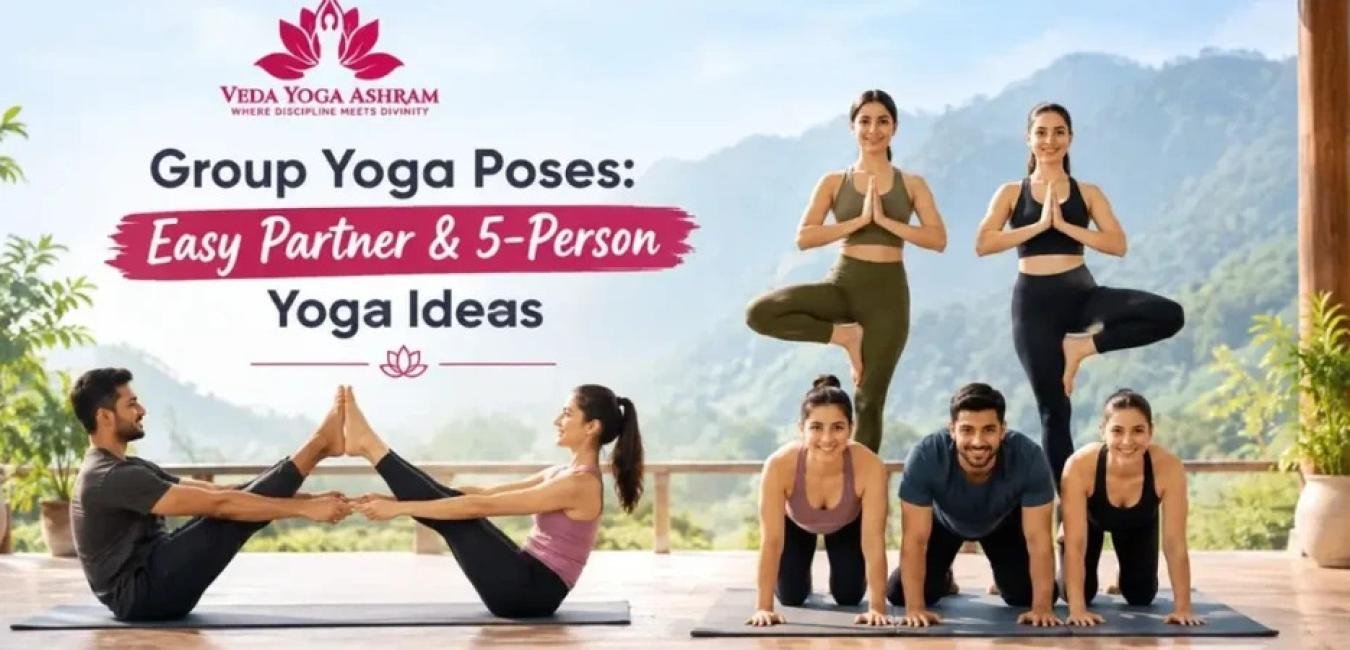
Group Yoga Poses: Easy Partner & 5-Person Yoga IdeasOur Yoga Blogs
Yoga is often done by oneself. Doing a session with friends, family, classmates, or a yoga group can make for a completely different kind of experience. Moving together can help with coordination, communication, and awareness of the body. You can have fun while still letting each person go at their own pace.
Group yoga poses that are done in a group can be especially nice for people who are just starting out because they do not require moves or hard balancing. A simple setup, breathing together, and easy motions can be all that is needed to build a feeling of togetherness.
This guide is about practices that are good for beginners in a group setting, especially when there are five or more people. It also includes ideas for making the session a comfortable and safe place for everyone.
Table of Contents
- What are Group Yoga Poses?
- How to Prepare for a Group Yoga Session?
- Pick a Gentle Speed
- Agree on Easy Ways to Talk
- Don’t Force Any Touch
- Group Yoga Poses for 5 People Without Lifting
- 5 Easy Group Yoga Poses
- 1. Five-Person Mountain Circle
- 2. Group Side Stretch
- 3. Five-Person Warrior II Circle
- 4. Group Tree Pose
- 5. Five-Person Cat-Cow
- Benefits of Group Yoga Poses
- Encourages Motivation
- Develops Coordination
- Builds Group Connection
- Improves Body Awareness
- Makes Yoga Enjoyable
- Safety Tips for Group Yoga
- How to Create a Simple 20-Minute Group Yoga Routine?
- Group Yoga Poses for Beginners: How to Make Them Easier
- Group Yoga vs Partner Yoga
- Can Children and Older Adults Do Group Yoga?
- How to Choose the Best Group Yoga Poses?
- Wind-up
What are Group Yoga Poses?
Group yoga means doing yoga poses or movements with others at the same time. Some group yoga activities don’t need any touch. Others might include touches, like hand or fingertip contact.
The goal is to bring personal yoga practice and shared movement. People can match their breathing face the way to form a circle or line up their mats in a clear pattern.
This is not the same as acro yoga, where one person lifts, supports, or balances another. Group yoga can be gentle and simple for beginners. Everyone stays in control of their body and how far they move. For your session, pick moves that are easy to start, comfortable to hold, and simple to stop.
How to Prepare for a Group Yoga Session?
Before starting a session, check that there is space for everyone to move freely without running into each other. Each person needs a yoga mat and clothes that make it easy to move around. Items like blocks, blankets, straps or strong chairs can also be there for people who need help.
Place the mats carefully so that hands, feet, and heads have space. A circle is really helpful because people can see each other and move in the way.
Pick a Gentle Speed
The person who is least experienced should never feel like they have to keep up with someone Level of flexibility, balance, or strength.
Agree on Easy Ways to Talk
One person can lead the changes by counting breaths or letting everyone know when it is time to switch sides.
Don’t Force Any Touch
Everyone should feel okay with any contact, before holding hands or touching another person. No one should push, pull or try to make someone stretch more.
Group Yoga Poses for 5 People Without Lifting
When a group of five people gathers simple formations can create an experience without the need for lifts, pyramids or hard partner balances. Everyone should stay responsible for their balance and movement. This makes the session easier to manage when participants have varying experience levels.
Five participants can use formations such as:
- A circle
- Five mats facing inward.
- Five mats arranged like spokes.
- A semicircle
- Two rows, with one person leading.
The formation can change throughout the practice while the actual movements stay simple.
5 Easy Group Yoga Poses
If you are looking for group yoga poses for five people these five options offer a way to practice together while letting each person control their own movement.
1. Five-Person Mountain Circle
Stand in a circle with space between each person. Start in Mountain Pose with your foot on the ground and your arms by your sides. Take a few breaths together.
On a breath slowly lift both arms above your head. Reach up through your fingers while keeping your feet on the floor. Hold for a breaths and then lower your arms together.
Why do it: This simple setup helps with working being aware of breathing, good posture and moving as a group.
For beginners: If lifting the arms above your head is difficult, keep them at chest height.
2. Group Side Stretch
Stay in the circle with your feet a distance apart. Lift one arm over your head. Gently lean to the other side while keeping both feet on the floor. Go back to the middle. Do the same on the other side. Everyone moves at the time but each person has their own space.
Why do it: This move helps with group movement. Gently stretches the sides of the body.
Important: Do not pull another person’s arm to make the stretch bigger.
3. Five-Person Warrior II Circle
Place five mats in a circle with everyone facing a little. Step your feet apart. Turn one foot out. Bend the knee and stretch your arms in opposite directions. Keep your body straight and the back leg active without locking the knee. Hold for a breaths before straightening the front leg and switching sides.
Why do it: Warrior II helps build strength in the legs, balance and awareness of the body while letting each person work on their own.
Beginner tip: Use a step and a less bent knee.
4. Group Tree Pose
Stand in a circle. Start in Mountain Pose. Shift your weight to one foot. Place the foot next to the standing foot with the toes on the floor against the lower leg or higher on the inner thigh when it feels right. Keep your hands at your chest raise them above your head or stretch them out. Hold for a breaths before switching sides.
Why it: Tree Pose improves balance and concentration.
Important: Do not put the lifted foot directly against the standing knee.
5. Five-Person Cat-Cow
Place five mats in a circle. Face the center. Get on your hands and knees with space, between each person. For Cow Pose breathe in. Gently arch your back while lifting your chest. For Cat Pose breathe out. Gently curve your back. Do this slowly for five to eight times.
Why do it: This movement helps with moving the spine. Helps everyone breathe together before moving on to harder poses.
Modification: If your wrists feel uncomfortable use fists, blocks, forearms or do the movement while sitting.
Benefits of Group Yoga Poses
Encourages Motivation
Practicing yoga alongside others can make it easier for people who find solo exercise repetitive to stay engaged.
Develops Coordination
Moving together requires attention to timing, breathing, posture, and transitions when practicing yoga.
Builds Group Connection
Common physical activity facilitates communication, collaboration, and inspiration amongst the members while practicing yoga.
Improves Body Awareness
Participants need to pay attention not to their position but also to the space around them while practicing yoga.
Makes Yoga Enjoyable
A relaxed group setting can add variety, playfulness, and a stronger sense of participation in yoga. Research, on group-based activity more broadly suggests that social connection can influence motivation and participation, although the effect differs between individuals when practicing yoga.
Safety Tips for Group Yoga
Safety becomes especially important when several people share the same practice area. Do not assume that everyone has the same mobility, balance, strength, or experience.
- Keep Enough Space: Everyone should be able to extend the arms and legs without touching another participant.
- Do Not Push or Pull: A partner should never force another person's body deeper into a posture.
- Avoid Weight-Bearing Group Poses: Beginners should avoid lifts, stacked balances, pyramids, and positions where one participant carries another person's weight unless they have specialized instruction.
How to Create a Simple 20-Minute Group Yoga Routine?
I think a short routine can be enough to introduce beginners to shared movement.
1. Centering – 2 Minutes
We. Stand comfortably. We take slow breaths together.
2. Mountain Circle – 3 Minutes
We use the opening posture. We establish alignment, breathing and group rhythm.
3. Side Stretch – 3 Minutes
We move gently from left, to right. We breathe together.
4. Warrior II – 4 Minutes
We practice both sides. We use a stance.
5. Tree Pose – 4 Minutes
We hold each side for breaths. We allow participants to use modifications.
6. Cat-Cow – 2 Minutes
We finish the sequence with gentle spinal movement.
7. Quiet Rest – 2 Minutes
We end in a seated position or Savasana. This structure gives the session direction without making it overly demanding.
Group Yoga Poses for Beginners: How to Make Them Easier
Beginners do not have to perform the most advanced version of a posture.
You can make group yoga poses easier by:
- Widening or shortening the stance
- Using a yoga block
- Sitting on a folded blanket
- Practicing near a wall
- Using a sturdy chair
- Reducing the holding time
- Keeping the range of movement smaller
Everyone in the group does not need to use the same modification. One participant may perform a full Tree Pose while another keeps the toes on the floor. That is completely acceptable. The aim is coordinated practice, not identical physical shapes.
Group Yoga vs Partner Yoga
Group yoga and partner yoga overlap but group yoga and partner yoga are not exactly the same. Group yoga generally means people practicing together often independently, within a shared formation. Group yoga involves people in the same space each doing their own postures.
Partner yoga usually involves two people working together. Partner yoga may include physical contact or mutual support.
Both group yoga and partner yoga can be included in a session but beginner groups should introduce cooperation gradually.
With five participants independent postures performed in a shared formation are often easier to manage than complicated partner-based techniques. With five participants independent postures are easier to manage than complicated partner-based techniques.
Can Children and Older Adults Do Group Yoga?
Yes yoga can be adapted for people of ages and for people, with different levels of mobility. Children must have supervision and must not climb on lift or pull other people. Older adults or people who have limited mobility may find chairs shorter ranges of movement and slower transitions useful.
Seated versions of Mountain Pose, side stretching, Warrior II and Cat-Cow can make a yoga session easier to follow. The instructor should put safety and personal comfort first than trying to make every participant look exactly the same.
How to Choose the Best Group Yoga Poses?
The best group pose is not always the one that looks the most impressive.
- When picking a pose ask:
- Can everyone get into and out of the position safely?
- Does every participant control their movement?
- Is there room between people?
- Can the posture be modified easily?
- Does it match the experience level of the group?
For people who're new to yoga these questions matter more than choosing a posture just because it looks good in a photo.
Related Post:- Hatha Yoga for Beginners
Wind-up
Group yoga poses can transform a yoga class into a shared experience, even without complex partner moves. With a group of five, circles, lines and spoke‑style formations can build teamwork and togetherness. Each participant can keep responsibility for their movement.
The best options are easy to start simple to change, and comfortable to finish. Mountain Pose, Side Stretch, Warrior II Tree Pose and Cat‑Cow are choices for beginners and for mixed‑level groups.
At Veda Yoga Ashram yoga can be explored as a practice. It includes postures, breath awareness, meditation, and traditional yogic learning.
Whether you practice with friends, family, students, or a community group focus on comfort, communication, and awareness. The best shared practice is one where everyone can participate safely and enjoy moving and breathing together.
 Q. What are the best group yoga poses for five people?
Share Post
No Comments Yet