Pranic Healing: Meaning, How It Works & Benefits ExplainedOur Yoga Blogs
Walk through the lanes of Rishikesh and you will see signs for energy healing, aura reading and pranic healing next to the yoga schools and cafes. If you are new to India, it is hard to tell which of these are old yogic traditions, which are modern inventions and which are worth your money.
This guide explains pranic healing in plain language. You will learn where it comes from, how a session works, what research exists, and how to stay safe. It does not give medical advice, and nothing here replaces a conversation with your doctor.
In short: pranic healing is a no-touch energy practice developed in the 1980s by Master Choa Kok Sui. The practitioners claim that they “scan, clear, and energize” the energy field of the individual. Scientific studies regarding it are sparse; hence, it should be taken only as an aid to conventional medicine.
Table of Contents
- What is Pranic Healing?
- Pranic Healing Meaning: The Ideas Behind the Name
- What Does Pranic Mean?
- Aura, Chakras and the Energy Body
- Prana in Classical Yoga vs Pranic Healing
- How a Pranic Healing Session Works?
- Pranic Meditation and Self-Practice
- Pranic Healing Benefits: What People Report and What Research Shows
- What People Commonly Report
- What the Research Shows
- Claims to Be Careful With
- Safety and Who Should Be Careful
- Pranic Healing in Rishikesh: Practical Tips for International Students
- Common Myths About Pranic Healing
- Conclusion
What is Pranic Healing?
It is a structured system of energy healing built around prana, the Sanskrit word for life force or breath. A practitioner works with their hands a few inches from your body, without touching you. They follow a fixed order: scan the energy field for areas they judge congested or depleted, sweep away what they call used-up energy, then direct fresh prana into the area.
The system was created by Master Choa Kok Sui, and practitioners learn it through graded courses. This is not a regular yoga practice or a medically certified therapy. In most countries, including India, anyone with a course certificate can offer sessions, since no single body regulates the title.
Pranic Healing Meaning: The Ideas Behind the Name
The name combines two simple ideas. “Pranic” refers to prana, and “healing” refers to the goal of supporting recovery. The human body is said to possess a field of energy which encircles and complements the physical body. In their view, a clean, well-supplied energy body helps the physical body recover faster.
What Does Pranic Mean?
Pranic is the adjective form of prana. It simply means “relating to prana.” Prana itself is an old Sanskrit word for breath, vitality or life force, and it appears throughout yoga philosophy and in breathing practices (pranayama). Thus, the definition of pranic practice is any practice utilizing prana. People sometimes type “prana healing” or even “panic healing” by mistake, and they mean the same thing.
Aura, Chakras and the Energy Body
Pranic healing uses a few terms you will hear again and again:
- Aura: an invisible energy field said to surround the body.
- Chakras: energy centers said to take in prana and pass it to organs and emotions.
- Scanning, cleansing and energizing: the three working steps of a session.
These are traditional or system-specific ideas. Scientists have not found an aura or chakras as measurable structures in the body, so it is more accurate to treat them as a framework practitioners use, not as proven anatomy.
Prana in Classical Yoga vs Pranic Healing
Students often assume that pranic healing is simply yoga’s ancient view of prana. The two are related but not the same.
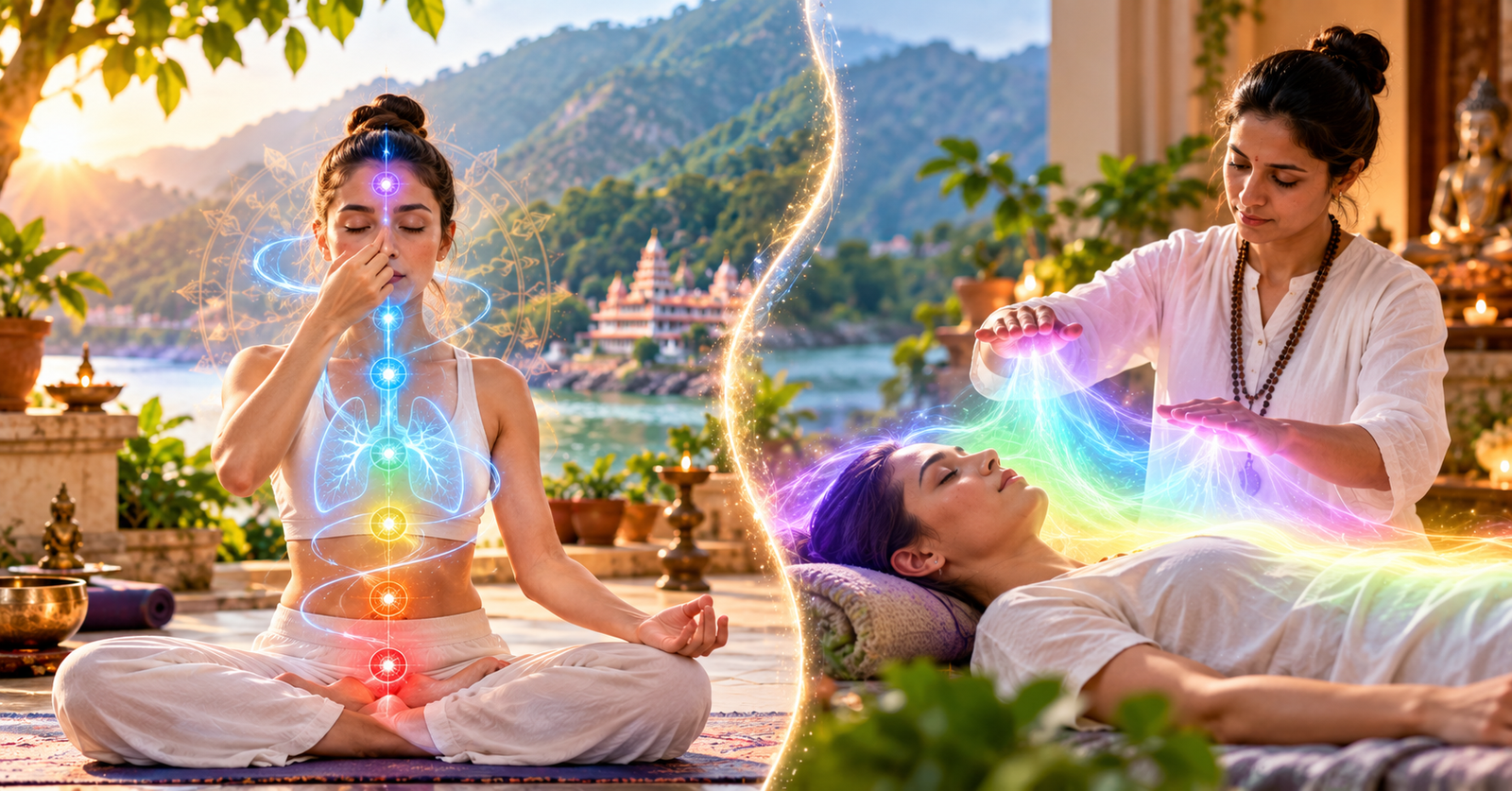
In classical yoga, prana is something you work with yourself, through breath, posture and meditation. Pranayama is the most direct method, and it is part of the Raja Yoga path described in the four paths of yoga. The practitioner is the one who practices.
Pranic healing, by contrast, is something one person does to or for another. The system is modern, it has its own curriculum, and it uses yogic vocabulary in a new structure. Knowing this difference helps you ask better questions when someone says their method is “ancient.”
How a Pranic Healing Session Works?
Sessions are quiet and usually last 20 to 60 minutes. You stay clothed and sit or lie down. A typical session runs like this:
- Talk: the practitioner asks what brought you in and what you hope for.
- Scanning: the practitioner slowly moves their hands over the body in an effort to feel areas they read as congested or weak.
- Cleansing: sweeping motions meant to remove used-up energy.
- Energise: the practitioner energises the areas they identified with new prana.
- Closing: often advice to drink water and rest.
People describe sensations such as warmth, tingling, heaviness or a deep sense of calm. Some feel nothing at all, and that is fine too. No touch, needles or manipulation should be involved. If a practitioner wants to touch you, press you for extra payments or promise cures, walk away.
Pranic Meditation and Self-Practice
Some people use the term pranic meditation for meditation practices that focus attention on prana and the breath. Within the pranic healing system, the best-known example is the Meditation on Twin Hearts, a guided group practice taught by Master Choa Kok Sui’s organization. Outside that system, the phrase is used loosely.
If you want a simple, low-risk prana awareness exercise, try this:
- Sit comfortably with your spine tall and your eyes closed.
- Breathe slowly through the nose for a minute.
- Rest your hands on your knees with the palms up.
- Notice any warmth, tingling or heaviness in the hands and arms without trying to produce it.
- Stay for five to ten minutes. If your mind wanders, return to the breath.
Some students also add a silent mantra, such as Om Namah Shivaya, as a point of focus. Stop if the practice makes you anxious or uncomfortable, and talk to a teacher or health professional if that continues.
Pranic Healing Benefits: What People Report and What Research Shows
What People Commonly Report
Many people who try pranic healing say they feel relaxed, calm or lighter afterward, and some say they sleep more easily. These reports are real experiences. Lying still in a quiet room while someone gives you undivided attention is relaxing on its own, so these feelings do not prove that an energy field exists.
What the Research Shows
The research is limited. The best-known study is a 2018 trial. It was a randomised, double-blind trial of 52 people with mild to moderate depression, who received either pranic healing or mock healing, alongside antidepressant medication, in weekly 20-minute sessions over several weeks. The group that received real sessions showed more improvement in depression category.
That result is interesting, but it is one small study, in one setting, on one condition, and the participants were also taking medication. Other studies exist, mostly small and from India, and their quality varies. None shows that pranic healing treats a disease on its own. So the fair summary is that the question is open, and pranic healing is not an evidence-based treatment for any condition.
Claims to Be Careful With
- Promises to cure diseases, or to reverse chronic conditions
- Advice to reduce or stop medication
- Diagnosing illness from an energy scan
- Claims of guaranteed results, or “remote healing” that works at any distance
- Large prepaid packages sold on promises of a cure
Safety and Who Should Be Careful
The session itself carries almost no physical risk. The real risk is substitution: leaving a condition untreated, or delaying care, because you trust a healing session more than a doctor.
- Keep seeing your doctor, and never stop or change medicine because of a session.
- If you have a serious or worsening condition, get a medical assessment first.
- If you live with a mental health condition, tell your doctor or therapist that you plan to try it, and do not use it in place of treatment.
- If a session leaves you distressed, anxious or confused, stop and speak to a qualified professional.
- If you feel unsafe or in crisis, contact local emergency services or a mental health helpline right away.
Pranic Healing in Rishikesh: Practical Tips for International Students
Rishikesh offers everything from serious teachers to casual stalls, and the quality varies a lot. A few simple checks protect your time and money:
- Ask which course levels the practitioner completed, and with which organization.
- Ask whether they work alongside medical care. The right answer is yes.
- Ask what they do not treat. A practitioner with no limits is a warning sign.
- Ask for the price of one session before you agree to a package.
- Avoid anyone who diagnoses illness, sells supplements or pressures you.
- Bring a list of your health conditions and medicines, and tell your doctor about your plans.
If you mainly want calm, focus and a better understanding of prana, practices such as pranayama and meditation are well known in yoga and cost little. Ask Veda Yoga Ashram how its classes approach breathing and meditation, and whether beginners receive guidance. Confirm current visa rules with official sources before you travel.
Common Myths About Pranic Healing
- “It is an ancient yoga technique.” The system is modern, created in the 1980s, though it borrows yogic ideas.
- “Science has proven it works.” Research is limited, and no study shows it treats disease.
- “It is the same as Reiki.” Both are energy healing practices, but they have different origins, methods and training.
- “You can skip your doctor.” No. Use it, if at all, alongside medical care.
- “You must be spiritual to try it.” You can be curious and skeptical. Just stay critical.
Conclusion
Pranic healing can feel pleasant, and some people find it comforting. That is a fair reason to try it. It is not a reason to delay medical care, spend large sums or accept big claims. Ask questions, check qualifications and treat your own judgment as your best tool. Rishikesh rewards curiosity, and it also rewards a clear head.
 Q. Is pranic healing the same as Reiki?
Share Post
No Comments Yet